Places to Go
A Year of Meetup, Timeleft, and a Running Club: What Actually Changed
A tool-by-tool look at what a year of low-effort, repeated attendance actually produces, and where each route to meeting people quietly fails.
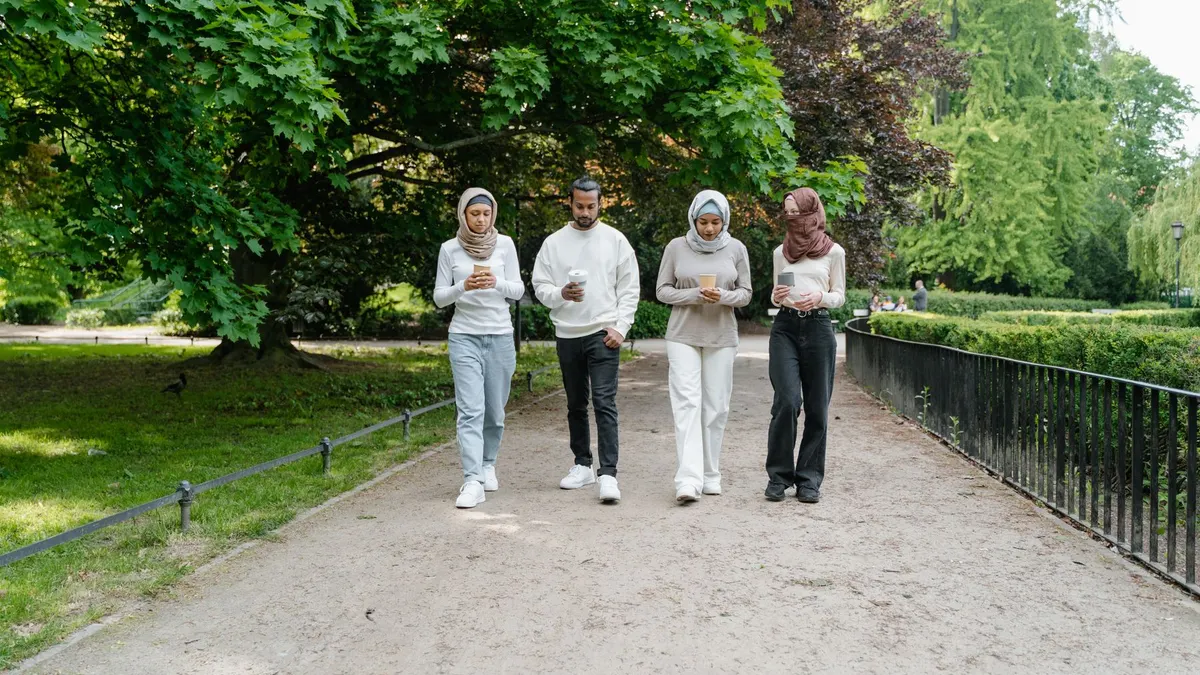
Nobody joins a running club expecting it to matter in month nine. They join it because month one feels bearable — an hour, a Tuesday, people who won’t ask too much of them. The problem with every article about meeting people is that it stops at month one. This one is about what happens after that, once the novelty is gone and the only thing left is whether you keep showing up.
Robert Putnam’s argument in Bowling Alone was never really about bowling leagues. It was about the difference between the thing you do once and the thing you do on a schedule, for years, with the same people. That second kind is what actually builds what he called bridging capital — the loose, useful, unglamorous web of people who’ll wave at you, cover a shift, tell you about a job. Nothing in this article works quickly. That’s the point of it.
Month one: everything feels roughly the same
At the start, Meetup, Timeleft, a running club, and a Wednesday night at a curated Buffet table all look identical. You show up somewhere with strangers, it’s slightly awkward, you go home. Meetup is the oldest of these by two decades — it’s built around recurring interest groups rather than one-off events, and it’s free to join an unlimited number of them, which matters if you’re trying several things at once without committing money to any of them. Timeleft seats small groups for a weekly dinner, matched by a personality questionnaire, with no messaging beforehand, so the first conversation happens at the table rather than in a chat window. Buffet now runs on a slightly different logic: a set of curated experiences posted each week, a seat you claim, a table that only goes ahead once three people have joined, and groups capped at six so it never turns into a mixer. There’s also a one-to-one mode if six strangers sounds like too much. A running club or a library programme costs nothing and has no app at all — you just turn up at the time on the sign.
By week four, the honest answer is: nothing has changed yet. Robin Dunbar’s work on social bonding suggests forming a genuinely close relationship takes something like 200 hours of shared time — that’s not a number to panic about, it’s a number that tells you month one was never going to feel like anything.
Month three: the sorting happens
This is where the four routes stop looking the same, because they fail in different ways.
Meetup’s weakness shows up here. Because it’s free and low-friction to browse, groups are uneven — some meet every week for years, others post an event, get twelve RSVPs, and vanish. You spend month two and three finding out which of your local groups are the first kind. That sorting cost is real and nobody warns you about it.
Timeleft’s weakness is the opposite. The dinner is genuinely well-run for a single evening, but because it’s designed around a new table each week, there’s no structural mechanism for seeing the same four people again. You get a good evening repeated with different strangers, which is pleasant but doesn’t accumulate the way a standing group does, unless you and someone at the table independently agree to keep meeting outside the app.
Buffet’s group mode has a similar shape to Timeleft’s — new table, new week — though its one-to-one mode can turn into something more like a standing arrangement if both people want that, since it’s just two people and a place rather than a rotating group.
A running club or a library reading group has the opposite problem to Meetup: it’s usually reliable, because it existed before any app did, but it depends on the place surviving. Research on third-place availability across the US found closures in every category of informal gathering spot between 2019 and 2021 — coffee shops, libraries, recreation centres, restaurants — and those losses landed hardest in places already short on social infrastructure. The club is only as durable as the room it meets in.
Month six: the actual mechanism starts to work
If you kept going with any one of these past the sorting period, month six is where something real usually shows up: you recognise faces. Not friends yet. Faces. The person who’s always at the Thursday run, the couple who keep turning up to the same Timeleft night in your city because you both liked it, the Meetup regulars who now say your name when you walk in.
This is the unglamorous mechanism behind everything. It isn’t chemistry. It’s repeated, low-stakes exposure to the same people, which is the exact thing that stopped happening for a lot of people once commutes, offices, and third places thinned out. The American Enterprise Institute’s 2021 survey found that the share of American men reporting six or more close friends fell from 55% in 1990 to 27%, and that 15% of men now report having no close friends at all — a fivefold rise since 1990. That collapse didn’t happen because people got worse at making friends. It happened because the settings that used to put the same people in the same room, repeatedly, for years, disappeared.
Month twelve: what you actually have
A year in, none of these tools has produced a best friend, and expecting one is the wrong measure. What a year of showing up produces is a layer — the acquaintances who’d notice if you stopped coming, the people you’d text if you needed a favour, the standing plan that removes a Tuesday-night decision you’d otherwise make while too tired to make it. Harvard’s 2021 survey found that among lonely young adults, roughly half said no one had taken more than a few minutes recently to ask how they were doing in a way that felt genuine. A year of repeated attendance is a slow, indirect way of fixing exactly that — not through one deep conversation, but through enough small ones that somebody eventually asks and means it.
The mortality research gives this some weight beyond feeling better. Julianne Holt-Lunstad’s 2015 meta-analysis found that social isolation and loneliness carry mortality risk on the same order as several well-established health risks, and the effect held even after adjusting for existing health status. That’s a strong claim resting on a genuinely large body of evidence, and it’s the reason a low-effort habit sustained for a year is worth more than it feels like in month one.
What to actually pick
If you want structure with no cost and don’t mind sorting through some dead groups, Meetup is still the widest net. If a single good evening matters more to you than building a standing group, Timeleft or Buffet’s dinner format will deliver that reliably, though neither guarantees you’ll see the same people twice unless you make that happen yourself. If your town still has a functioning library programme or run club, that’s usually the most durable option of all, precisely because it doesn’t depend on an app staying funded — only on the room staying open.
None of them work if you try them for three weeks and stop. That’s not a flaw in the tool. It’s the actual shape of the thing.
Where this comes from
- Bowling Alone: The Collapse and Revival of American Community
- Meetup: Interest-Based In-Person Group Events
- Timeleft: Weekly Dinners Matching Strangers by Personality
- The State of American Friendship: Change, Challenges, and Loss
- Loneliness in America: How the Pandemic Has Deepened an Epidemic of Loneliness
- Loneliness and Social Isolation as Risk Factors for Mortality: A Meta-Analytic Review
- Dunbar's Number: Why My Theory That Humans Can Only Maintain 150 Friendships Has Withstood 30 Years of Scrutiny
- Uneven Access to Essential Services and Amenities: Geographic Disparities in Third Place Availability Across the United States, 2010 to 2021
- Buffet's New App Tackles the Loneliness Epidemic by Connecting People in the Real World