Places to Go
What a Year of Showing Up Actually Buys You
Turning up to the same place, same time, most weeks, for a year does something specific to a social life — and it is not what most advice implies.
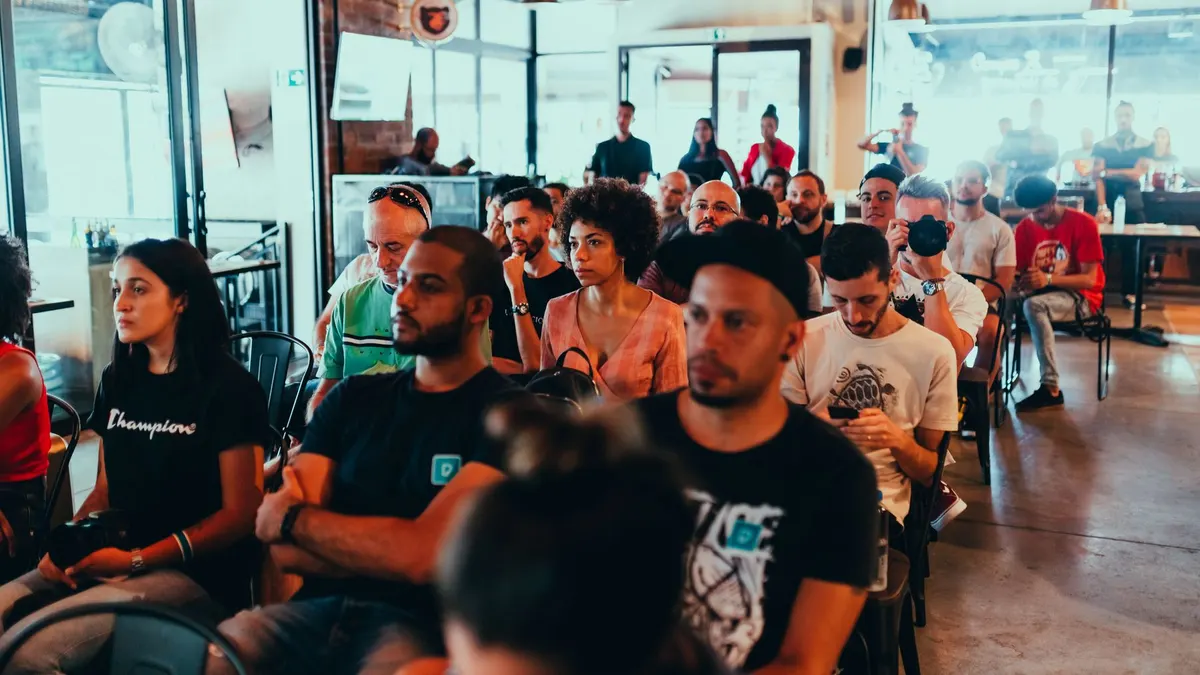
Nobody becomes friends with a stranger in one conversation. That is not a failure of the conversation. It is just not how it works. Most advice about meeting people skips this and talks as if the hard part is the first hello. The hard part is the fortieth.
So it’s worth asking, plainly: if you picked one place and went back most weeks for a year, what would you actually have at the end of it? Not “a fuller life” in the abstract. What, specifically.
The thing that changes is not friendship. It’s recognition.
For the first two or three months, showing up to the same running club, the same trivia night, the same library group, mostly gets you nodded at. That’s it. You’re a face. Maybe someone remembers your name by week six. This is slow and it can feel like nothing is happening.
But sociologist Ray Oldenburg, writing about what he called third places — the cafes, bars, and hangouts that sit between home and work — described this recognition as the actual mechanism. Third places work not because they produce instant intimacy but because they are low-stakes enough that you can be a regular before you are anyone’s friend. Being a regular is a status. It doesn’t require anyone to like you yet. It just requires you to be there often enough that your absence would be noticed.
That’s month three or four, roughly. Someone asks where you were last week. That’s the first payoff of a year of small effort, and it’s much smaller than people expect, and also more durable than a single good conversation, because it doesn’t depend on you having said anything memorable.
Month six is where the actual conversations start
Repetition does something that intensity can’t: it removes the pressure to make each encounter count. If you’re going to see the same six people again next Tuesday, you don’t need to extract a whole friendship from tonight. You can be quiet. You can be tired. You can talk about nothing.
Research on college students returning to in-person life after the pandemic found that it was the kind of connection that mattered more than the amount — specifically, connections that were regular and low-effort to maintain predicted wellbeing better than a wide but shallow social circle. A year of the same place gives you exactly that kind of low-effort regularity, but only once you’ve stopped treating each visit as an audition.
By month six, if the place has any social structure at all — a group activity, a shared table, a reason to talk to the same three or four people repeatedly — you should have at least one relationship that has moved past small talk. Not a close friendship yet. Something closer to: you know their job, they know you have a dog, you’ve started sitting near each other without discussing it.
What a year buys: a short list of actual names
By the twelve-month mark, the honest tally for someone who showed up reasonably consistently — say, three weeks out of four — looks something like this: a handful of people whose names you know and who’d say hello to you on the street; one or two you’d text if you needed a favor involving a car or a spare key; and, for some people, one relationship that has genuinely become a friendship independent of the place that produced it.
That’s not a huge number. It is, however, a number that most people trying to build a social life from scratch don’t currently have, and it is a number produced by roughly fifty low-effort evenings rather than one exhausting campaign of networking. Robert Putnam’s research on the decline of American civic life pointed to exactly this kind of repeated, low-stakes association — bowling leagues, club meetings — as the infrastructure that used to generate friendships as a byproduct of just doing something regularly with the same people. When that infrastructure disappears, so does the byproduct. A year at one place is, in a small way, rebuilding your own piece of it.
The American Enterprise Institute’s 2021 survey of American friendship found that 12% of Americans report having no close friends at all, up from 3% in 1990. That is not a motivation problem spread across millions of people simultaneously. It’s what happens when the settings that used to manufacture friendship — the union hall, the church group, the same five neighbors on the same porch — thin out. A year of showing up somewhere specific is a private fix for a structural problem, and it’s worth being honest that it is only a partial fix.
Why the place matters more than the activity
Eric Klinenberg’s research on social infrastructure argues that the physical space itself shapes how much contact happens — not just what’s programmed inside it. A library with tables where people linger produces more incidental connection than a library laid out for silent, solitary use, even if both technically offer a “book club.” This matters for choosing where to spend your year: pick a place built for lingering, not just attending.
That choice is getting harder to make well. A 2025 study in Health & Place tracked third places across the country — coffee shops, libraries, recreation centers, museums — and found closures across every category between 2019 and 2021, concentrated in lower-income and rural areas. A follow-up summary from the University of Colorado Boulder framed the loss of senior centers and churches specifically as a driver of loneliness, not just a casualty of it. If the place you’d choose has closed, or was never there, that’s not a personal failing to solve with more effort. It’s worth naming, and it’s part of why AARP’s surveys of adults 45 and older found loneliness tracking closely with the size and diversity of a person’s network — network size that depends heavily on whether nearby places to build one still exist.
What a year does not buy
It does not buy a best friend, reliably. It does not replace an old friendship from a life you left behind. And it does not work if the place changes every few weeks — a different Meetup group each time, a different bar because the last one felt awkward. The mechanism runs on sameness. Meetup’s own model, built on recurring groups rather than one-off events, works for exactly this reason when people actually keep going back to the same one.
The realistic promise of a year of small effort is narrower than most people want it to be, and also more achievable: not a transformed social life, but three or four people who know your name, one place where you’re expected, and evidence — hard-won, slow, and easy to underestimate while you’re in month three — that showing up is the whole method.
Where this comes from
- The Great Good Place: Cafes, Coffee Shops, Bookstores, Bars, Hair Salons and Other Hangouts at the Heart of a Community
- Bowling Alone: The Collapse and Revival of American Community
- Palaces for the People: How Social Infrastructure Can Help Fight Inequality, Polarization, and the Decline of Civic Life
- Uneven Access to Essential Services and Amenities: Geographic Disparities in Third Place Availability Across the United States, 2010 to 2021
- As Community Spaces Disappear, New Research Warns of Health and Equity Risks
- The State of American Friendship: Change, Challenges, and Loss
- Loneliness and Social Connections: A National Survey of Adults 45 and Older
- Social Connections Combat Loneliness and Promote Wellbeing Among College Students Coming Out of the COVID-19 Pandemic
- Meetup: Interest-Based In-Person Group Events